
Odio Foundry · Internal Venture Case Study
A Manual Process Got Uomma Off the Ground. An AI Platform Is Taking It to Scale.
Uomma connects Canadian businesses with vetted BIPOC virtual talent. The service works. The manual model behind it does not scale. Here is how Odio Foundry is building what does.
- Brand & Growth
- AI Platform Build
- Operational Scaling
Case Study
The Opportunity
Canadian Businesses Want Skilled Help. The Hiring System Cannot Deliver It Fast Enough.
Canadian businesses lose time and money on hiring before a single qualified candidate reaches the interview stage. Job boards return volume without fit. Recruiters charge for slow searches. Freelance platforms cater to short gigs, not the long-term operational support most founders and SMBs actually need.
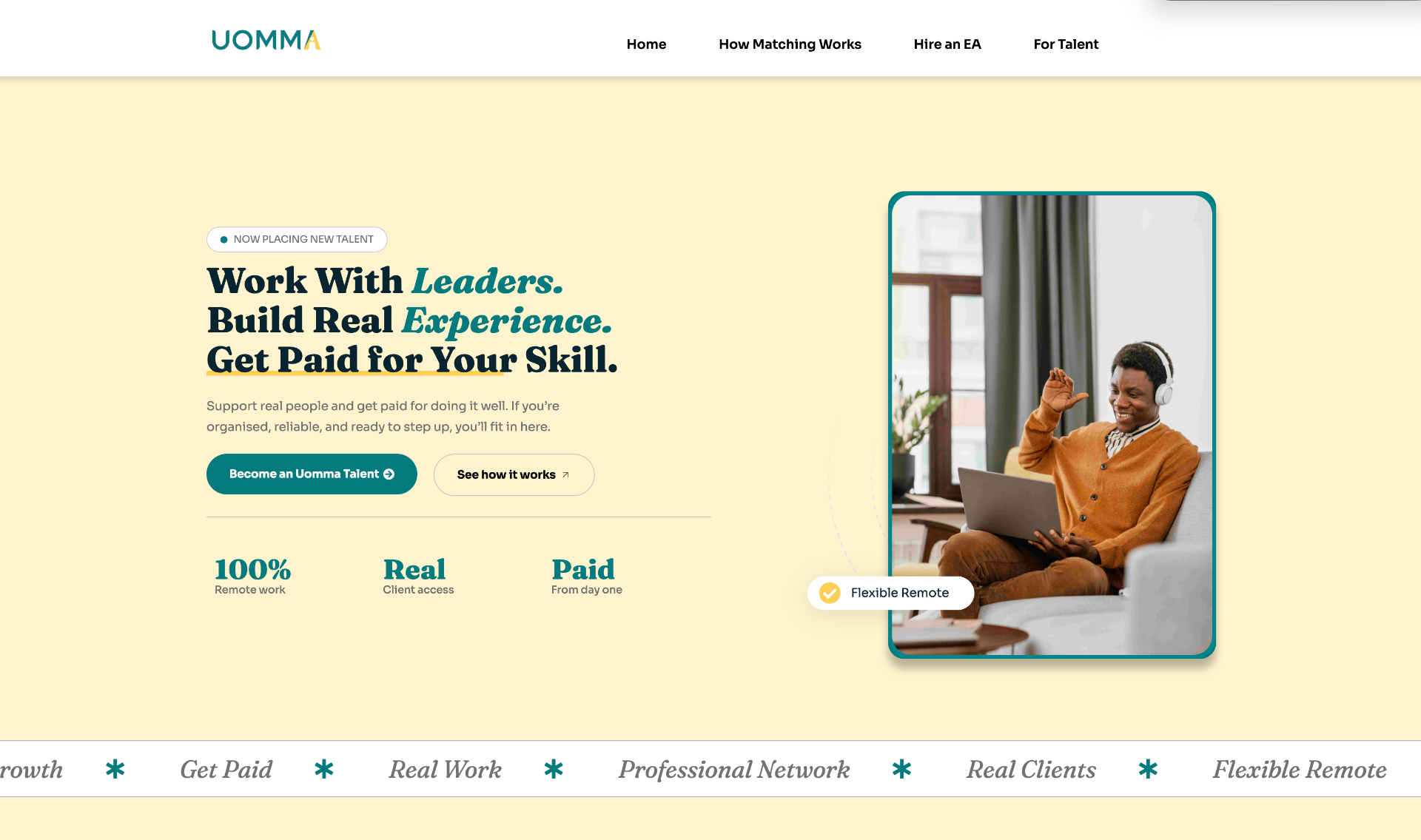
At the same time, skilled BIPOC professionals across North America and beyond struggle to access the Canadian market. Their experience gets discounted. Their applications go unseen. The talent exists. The infrastructure to match it does not.
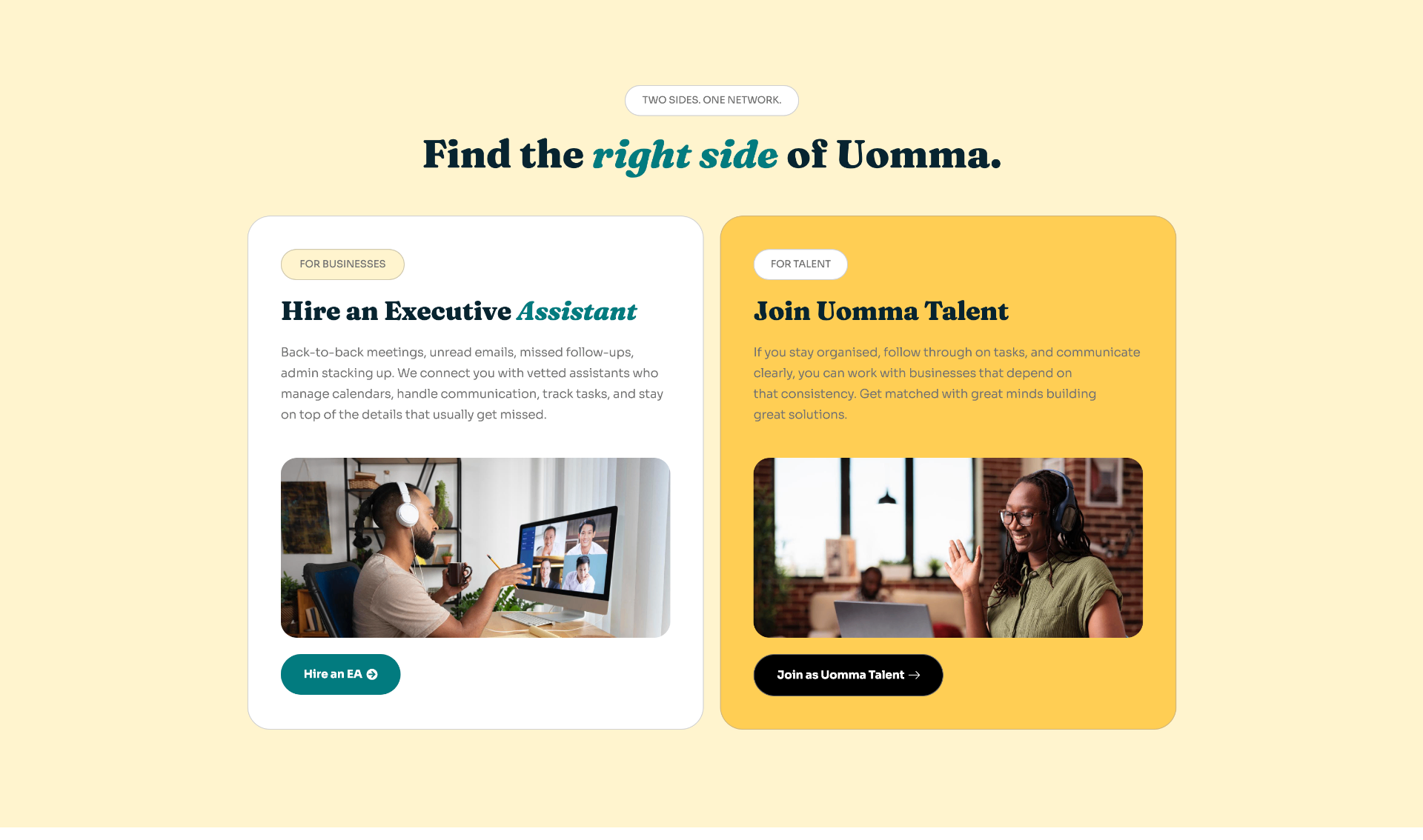
Sara Awatta saw this from both sides. As a consultant, she heard Canadian employers describe the same hiring frustration over and over. She also saw the depth of skilled BIPOC talent ready to work, blocked by hiring systems that had no way to recognise them. Uomma was built to close that gap.
The Thesis
A Long-Term Partnership Model, Not a Gig Marketplace.
Odio Foundry took on Uomma because the unit economics worked from day one. Canadian businesses needed reliable, vetted talent. BIPOC professionals needed access to that market. Favourable exchange rates made it affordable on both sides. The match was there. What was missing was the system to make it repeatable.
Three things had to be true for Uomma to scale beyond a service business. Vetting had to be rigorous enough that businesses trusted the match without burning a week on interviews themselves. The platform had to support long-term partnerships rather than transactional gigs, because that is where retention and margin live. And the operating model had to handle volume without the founder personally screening every candidate.
The first two were proven through the manual operation. The third is what the venture is building now.
"We are not trying to be the cheapest job board. We are building the trusted way for Canadian businesses to hire skilled BIPOC talent for the long term. That changes what the platform has to do." — Sara Awatta, Founder, Uomma
How We Are Building It
Keep the Service Running. Build the Platform That Replaces It.
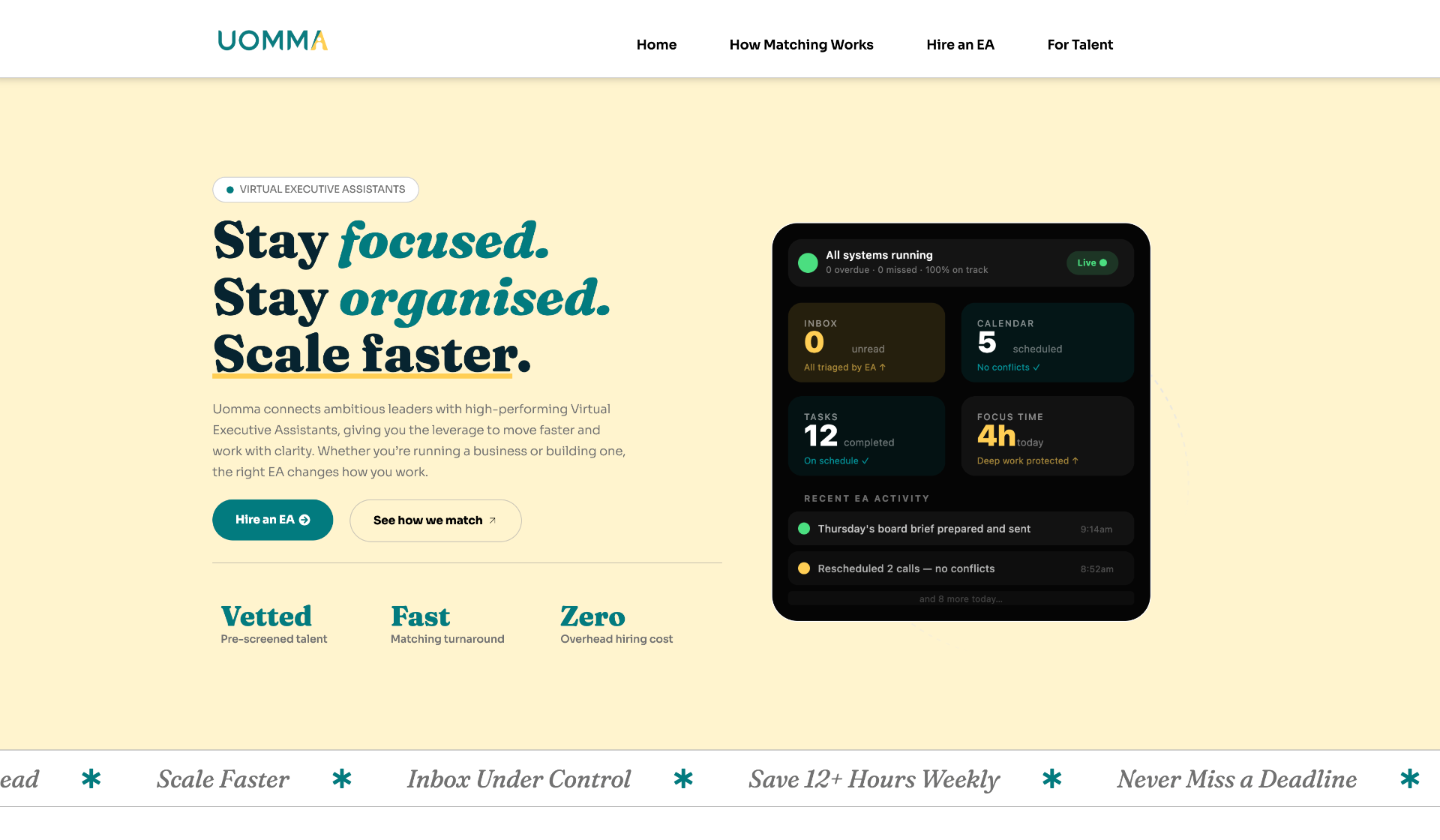
Uomma is operating today. Sara and the team run a manual pipeline: job description creation, personality assessment, resume and video pitch reviews, live interviews, training, matching, and feedback. The pipeline works. It also caps the business at whatever Sara and a handful of operators can personally process.
Odio Foundry's role is to keep that service running while building the platform that takes the manual work out of it. All three labs are active.
- Odio Digital — Brand & growth: brand bible, growth plan, website revamp, social and video content strategy, onboarding digitisation.
- Odio Tech — AI platform build: MVP for AI-driven candidate screening, interview workflow, client-side matching interface.
- Odio Ops — Operational scaling: client and EA onboarding systems, pricing analysis, infrastructure for growing talent pool.
The AI Platform
Scoped, Greenlit, In Build.
The MVP was scoped with Odio Tech in May. AI-driven candidate screening focused on interpersonal skills, with one to two job-specific questions. Automated reports generated for every candidate. A 70 percent cutoff score, with candidates below the threshold redirected to one to two months of training before reapplying. Interviews remain off-platform initially, with results uploaded back. Clients see pre-screened candidates aligned to their job requirements and submit match requests directly.
Target MVP go-live is June. A previous attempt to solve the same problem with a third-party tool failed a Canadian security audit and could not be customised to the workflow. Building it inside Odio Tech removes both constraints.
The Service Taxonomy
From One Role to Twelve.
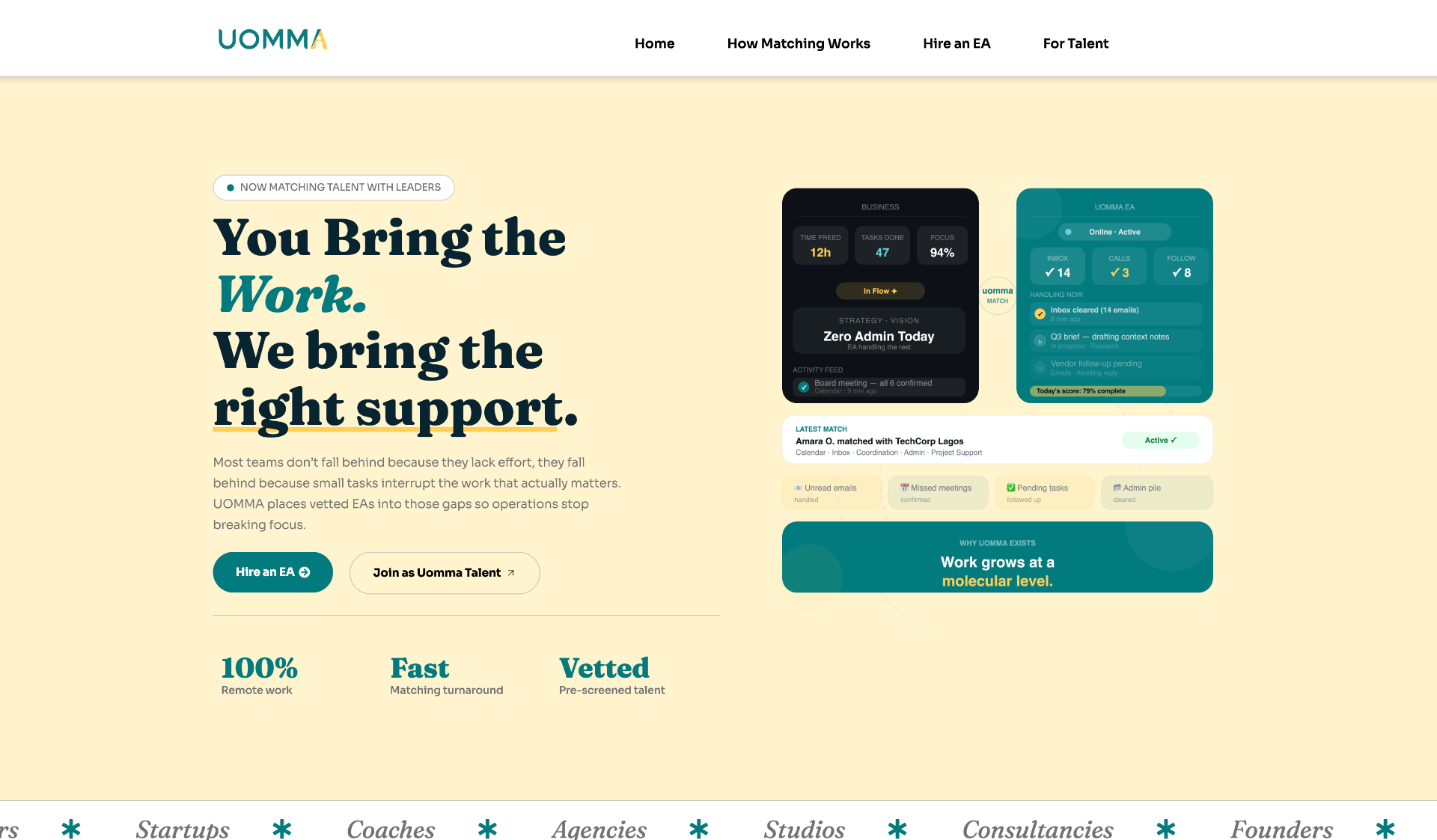
Uomma started with Executive Assistants. The platform supports twelve specialised roles across industries: Executive, Administrative, Bookkeeping, Marketing, Social Media, Sales, HR, e-Commerce, Customer Support, Real Estate, Legal, and Medical Office. Each role is positioned as a strategic partner, not support staff. The brand language reflects that: assistants who think tactically, anticipate needs, and drive measurable outcomes.
The Brand and Growth Engine
Odio Digital is running a full brand bible, growth plan, and website revamp in parallel with the platform build. Voice and visual direction are being tuned for Canadian, Nigerian, and wider diaspora audiences. A three-month growth plan covers content pillars, social direction, video content strategy, and onboarding digitisation. The goal is for the brand and the platform to launch together, with inbound demand ready when the system can absorb it.
Key Milestones
From Manual Service to Scalable Platform.
- Uomma operating with manual pipeline
job description, screening, interview, training, matching, and feedback all handled by hand.
- Q1 strategic plan set with Odio Foundry
30 to 50 client onboarding target, 1.2 to 1.5x quarterly growth multiplier, balanced offline outreach and digital acquisition.
Service taxonomy expanded from Executive Assistant to twelve specialised roles, each positioned as a strategic partner rather than support staff.
Website revamp underway with Odio Digital. Brand bible and three-month growth plan in development.
AI platform MVP scoped with Odio Tech in May. Build window of four to six weeks, with testing, feedback, and final QA following. Target go-live: June.
Odio Ops actively building client onboarding systems, pricing analysis, and operational infrastructure for a scaling EA pool.
Where It Stands
Operating Now. Scaling Imminently.
Uomma is live at uomma.com and actively placing virtual talent with Canadian businesses today. The manual operation continues to handle current demand while the platform is built underneath it. The Q1 plan is in motion. The MVP is scheduled for June. The brand and growth infrastructure will launch alongside it.
The expansion roadmap, agreed with Odio Foundry, extends beyond virtual assistants into software developers, HR talent, and engineering recruitment. The platform being built now is designed to absorb that expansion without rebuilding the matching engine each time.
What This Proves
Sara Awatta proved the business model with a manual operation. That is the hardest part. The studio model lets Uomma keep operating, generating revenue and learning, while the AI platform that replaces the manual work gets built in parallel by a team that already understands the venture. Integrated execution is not a tagline. It is what takes a working service to a scalable category leader.
Selected Visuals
A look at the work.
Partner With Us
Whether you're a founder ready to build, a growing brand ready to scale, or an operator who needs a real execution partner, the first conversation costs nothing. The right one changes everything.
More Work
View All →A media and technology platform creating a modern-day Black Wall Street.
Read more →An integrated food sovereignty platform growing, processing, and distributing culturally significant foods locally and year-round.
Read more →A financial education and advisory platform designed for immigrants in Canada.
Read more →